Many business owners think data governance and compliance are the same thing. Both are about protecting information, reducing risk and meeting your obligations, so it’s easy to see why.
They are different, though, and knowing the difference can save you time, money and stress:
UK businesses now face more cyber threats, updated data protection law and customers who expect their information to be handled properly. That makes the difference matter more than ever. Here it is in plain English.
What Is Data Governance?
Data governance is how your business manages its information from the day it’s created to the day it’s deleted. It covers:
- Who owns the data
- Who can access it
- Where it’s stored
- How long it’s kept
- How sensitive information is protected
- When and how it’s deleted
Without governance, data soon ends up spread across email inboxes, shared drives, laptops, personal devices and cloud apps. Nobody is quite sure what’s where.
A Simple Example
A member of staff creates a customer spreadsheet. Good data governance makes sure that:
- It’s saved in the right place
- Only authorised staff can open it
- It follows your retention policy
- Sensitive details are protected
- Everyone knows which version is current
Governance means everyone in your business handles information in the same, sensible way.
What Is Compliance?
Compliance means meeting the laws, regulations, standards and contractual requirements that apply to your business. Depending on your sector, these may include:
- UK GDPR and the Data Protection Act 2018
- The Data (Use and Access) Act 2025
- Cyber Essentials, which customers, insurers and public sector contracts often ask for
- ISO 27001
- FCA regulations for financial services
- The NHS Data Security and Protection Toolkit (DSPT) for organisations with access to NHS patient data and systems
Some of these are laws. Others are voluntary standards that become essential when a customer, insurer or contract requires them.
A Simple Example
UK GDPR says personal data must be protected and kept only for as long as it’s needed. Meeting that requirement is compliance. Being able to show how you meet it depends on good governance.
What’s Changed in 2026?
The Data (Use and Access) Act 2025 updates UK GDPR, the Data Protection Act 2018 and the privacy and electronic communications rules (PECR). It doesn’t replace them. Most of its changes started on 5 February 2026.
One change affects every business that handles personal data, however small: since 19 June 2026, you must give people a clear way to make a data protection complaint, acknowledge it within 30 days, look into it promptly and tell them the outcome.
The ICO (the UK’s data protection regulator) also has stronger powers. Fines under PECR, which covers marketing emails, texts, calls and cookies, can now reach £17.5 million or 4% of global turnover.
If your business doesn’t have a complaints process yet, that’s a governance gap and a compliance gap.
A Simple Way to Think About It
Think of it like driving:
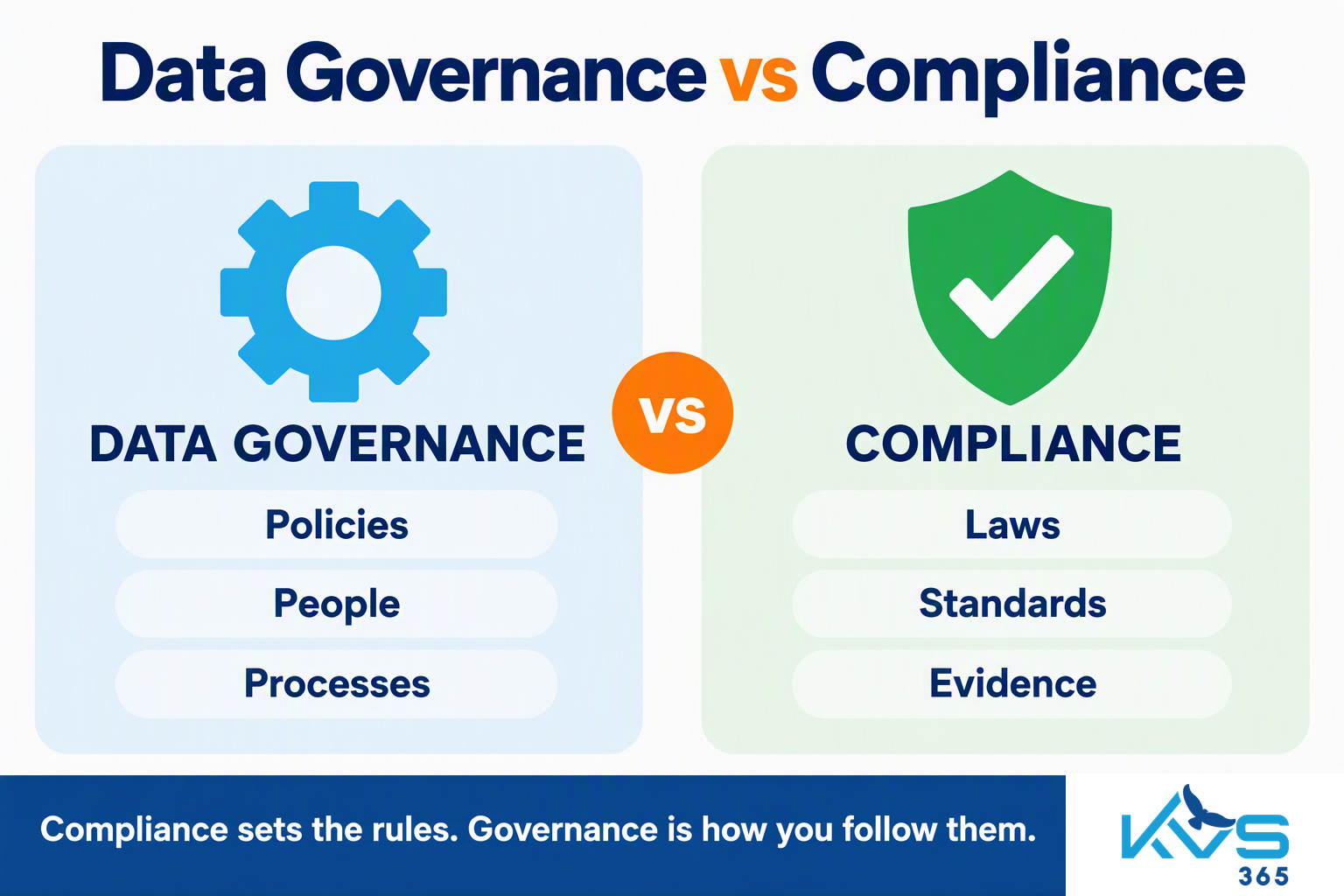
- Compliance is the Highway Code. It sets the rules everyone must follow.
- Governance is how you drive every day. Your habits, checks and servicing keep you within the rules without you having to think about it.
A driver who knows the Highway Code but never checks their mirrors is still a risk. A careful driver who ignores the speed limits will still get a fine. You need both.
Data Governance vs Compliance: Side by Side
| Data Governance | Compliance |
|---|---|
| Internal business framework | External laws, standards and contracts |
| Defines how data is managed | Defines what rules must be met |
| Improves data quality and control | Reduces legal and regulatory risk |
| Focuses on processes and responsibilities | Focuses on meeting and evidencing obligations |
| Driven by business needs | Driven by regulators, customers and insurers |
| Builds the foundation | Checks the outcome |
Why Many SMEs Get This Wrong
Many small businesses go straight to compliance. They download policy templates, fill in a Cyber Essentials questionnaire and hope for the best.
Without governance underneath, compliance turns into a paperwork exercise. When someone asks a real question, the gaps soon show:
- Where exactly is our customer data?
- Who has access to it, and do they still need it?
- Which files contain sensitive information?
- How long have we been keeping personal data?
- Could we answer a Subject Access Request within the deadline?
- Do we have a process for handling data protection complaints?
If answering these means searching old inboxes, shared drives and former employees’ accounts, your governance needs work.
When governance is in place, compliance becomes much easier. You already know what data you hold, where it lives, who can see it, how it’s protected and how long you keep it. Audits, customer security questionnaires and insurance renewals then become simple tasks rather than stressful scrambles.
Where Microsoft 365 Fits In
Many businesses already pay for tools that support governance and compliance but have never switched them on. They all sit within Microsoft Purview:
Governance tools
- Sensitivity Labels
- Data Classification
- Retention Policies
- Data Lifecycle Management
- Access Controls
Compliance tools
- Data Loss Prevention (DLP)
- Audit Logs (standard version)
- eDiscovery (standard version)
- Compliance Manager
Microsoft 365 Business Premium includes sensitivity labels, data loss prevention, message encryption and Compliance Manager. It also includes the standard versions of audit logging and eDiscovery. More advanced features, such as Insider Risk Management and the premium versions of audit and eDiscovery, are available through the Microsoft Purview Suite add-on for Business Premium.
If you’re on Business Basic or Business Standard, you may be missing some of these protections without realising it.
What Happens If You Ignore One of Them?
Without governance
- Duplicate or inaccurate records
- Uncontrolled file sharing
- Staff with more access than they need
- Data scattered across too many places
- Higher cyber security risk
- Difficulty responding to GDPR requests and complaints
Without compliance
- ICO investigations and fines
- Failed audits or lost contracts
- Problems with cyber insurance
- Damage to your reputation and customer trust
Governance and compliance work best as partners, not as separate projects.
The Bottom Line
The Data (Use and Access) Act 2025 is now fully in force and the ICO has stronger enforcement powers, so getting both right is no longer a nice-to-have for UK businesses. It protects your customers, your reputation and your bottom line.
Not Sure Where Your Business Stands?
Do you know what data you hold, where it lives, or whether you’d pass a data protection check? KVS365 helps UK small businesses close the gaps, using the Microsoft 365 tools you may already be paying for.
Start your free assessment
Leave a Reply