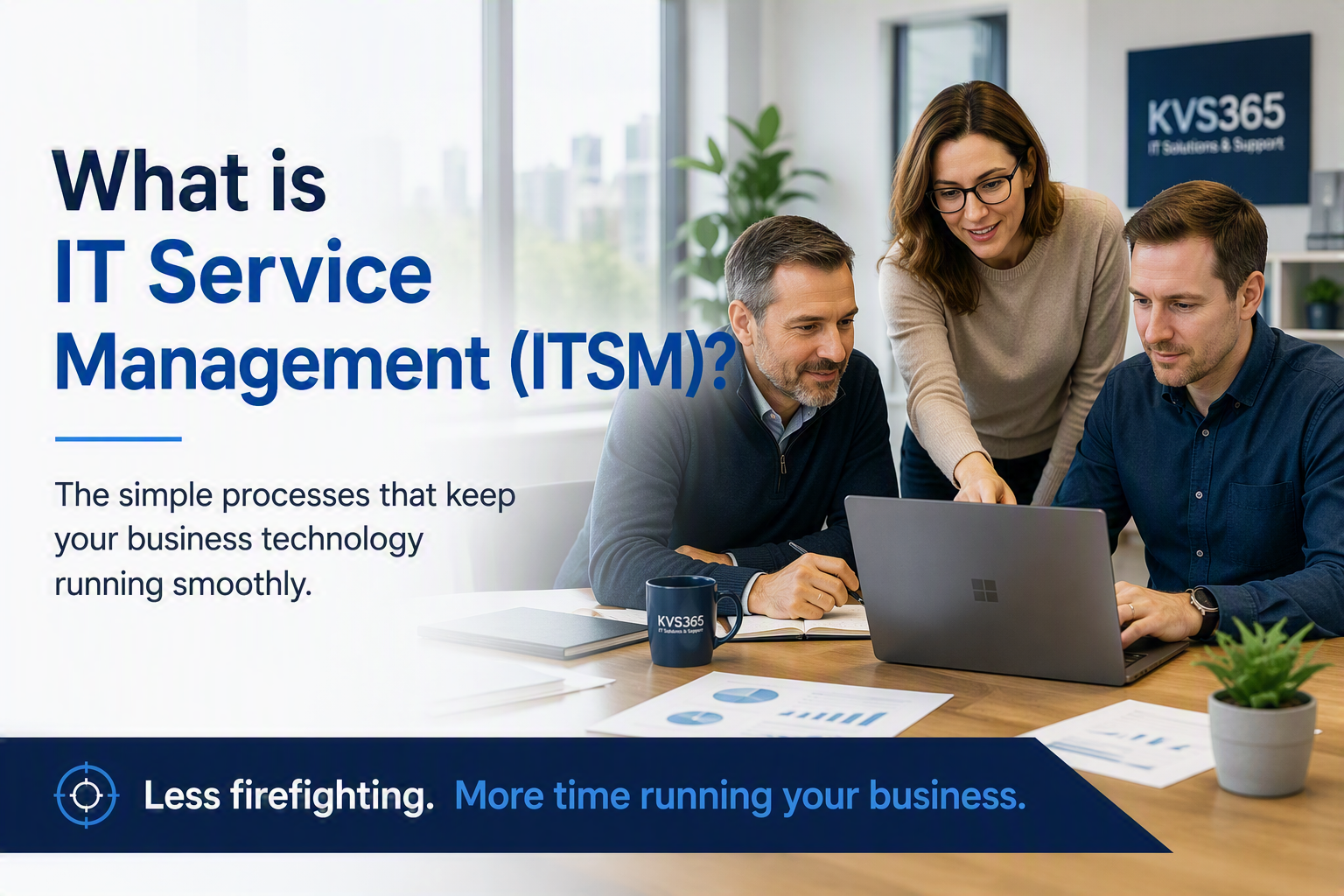
What is ITSM and Why Should Small Businesses Care?
Most business owners have never heard of the term ITSM, and that’s perfectly normal.
Yet almost every business relies on it every day without realising it.
ITSM stands for IT Service Management. In simple terms, it’s the way an organisation delivers, supports and improves its IT services. Rather than fixing technology only when it breaks, ITSM creates structured processes that keep systems running smoothly and ensure staff have the tools they need to do their jobs.
Think of IT Like Facilities Management
Imagine running an office building.
You need:
- Electricity
- Heating
- Security
- Cleaning
- Maintenance
You don’t wait until the lights go out before thinking about electricity.
You have processes, schedules and people responsible for keeping things working.
ITSM applies the same principle to technology.
It covers everything from setting up new employees and laptops to managing software, resolving issues and planning changes to business systems.
The Difference Between IT Support and ITSM
Many people assume ITSM is simply another name for an IT helpdesk.
It isn’t.
An IT helpdesk focuses on solving problems when users report them.
ITSM looks at the bigger picture:
- How are IT services delivered?
- How are requests managed?
- How are changes controlled?
- How are systems monitored?
- How are recurring issues prevented?
A good IT support team fixes today’s problem.
Good IT Service Management prevents tomorrow’s problem.
Everyday Examples of ITSM
You have probably experienced ITSM without knowing it.
New Employee Onboarding
When someone joins your business, they need:
- An email account
- A laptop
- Access to files
- Access to business applications
ITSM provides a repeatable process so nothing gets missed.
Password Resets
Instead of users wondering who to contact, there is a clear process to request support and get access restored quickly.
Software Updates
Businesses regularly need new applications or upgrades.
ITSM ensures updates are tested, approved and deployed without disrupting the business.
Security Incidents
If a suspicious email arrives or a device is infected with malware, ITSM defines exactly who responds and what steps are taken.
Why ITSM Matters for Small Businesses
Large enterprises have used ITSM for years, but it is becoming increasingly important for small businesses too.
As organisations rely more heavily on:
- Microsoft 365
- Cloud services
- Remote working
- Cyber security tools
- Compliance requirements
Technology becomes more complex.
Without a structured approach, businesses often experience:
- Inconsistent support
- Lost productivity
- Security gaps
- Delayed issue resolution
- Frustrated employees
ITSM helps create consistency and accountability so technology supports the business rather than becoming a source of stress.
How ITSM Supports Cyber Security
This is where ITSM becomes particularly important.
Many cyber attacks succeed because of poor processes rather than poor technology.
Examples include:
- Staff having unnecessary access
- Former employees still having active accounts
- Missing software updates
- Untracked devices
- Security incidents not being reported quickly
A mature ITSM approach helps ensure these processes are documented, followed and regularly reviewed.
This supports requirements found in frameworks such as Cyber Essentials and other security standards. (This is a best-practice observation rather than a statement from the cited sources.)
What Does Good ITSM Look Like?
A business with good ITSM typically has:
✅ A simple way for users to request help
✅ Clear processes for onboarding and offboarding staff
✅ Documented procedures for handling issues
✅ Defined responsibilities
✅ Asset tracking for devices and software
✅ Change control when systems are updated
✅ Regular reviews to identify improvements
The goal isn’t paperwork for the sake of paperwork.
The goal is making technology predictable, reliable and secure.
The Bottom Line
ITSM might sound like another piece of IT jargon, but the concept is actually very simple.
It’s about treating IT as a business service instead of waiting for things to break.
For small businesses, effective IT Service Management means:
- Fewer disruptions
- Faster support
- Better security
- Improved employee productivity
- Greater confidence that technology is helping the business grow
Technology should enable your business, not slow it down.
A good ITSM approach helps make that happen every day.
Leave a Reply