What is SIEM and Why Should Small Businesses Care?
When people think about cybersecurity, they often picture antivirus software, firewalls, and strong passwords. While those are all important, there’s another powerful tool working behind the scenes for many businesses: SIEM.
SIEM might sound like another complicated IT acronym, but the idea is actually quite simple.
What Does SIEM Stand For?
SIEM stands for Security Information and Event Management.
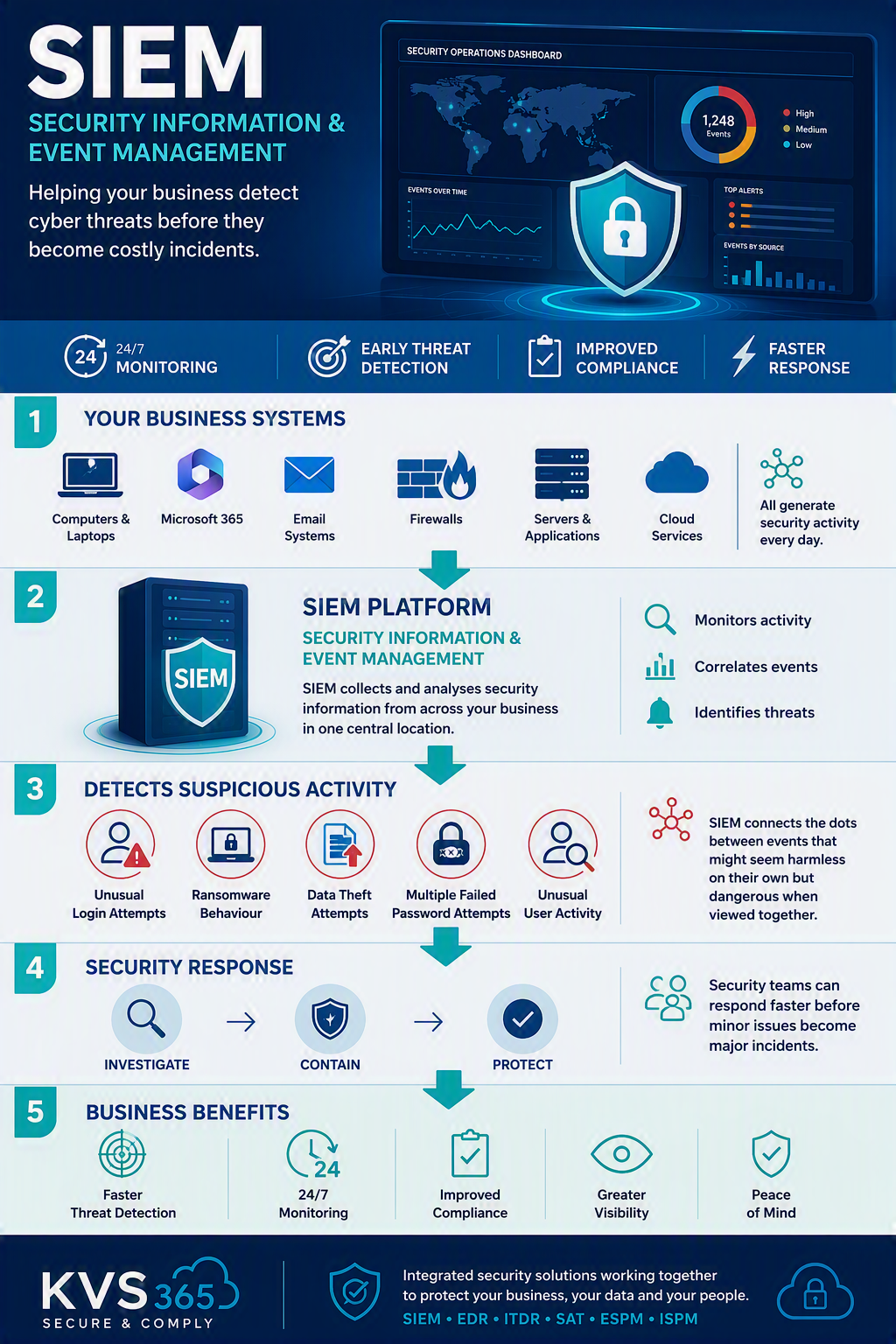
In plain English, it’s a system that continuously watches all of your technology systems, collects security information, and alerts experts when something unusual happens. Modern SIEM platforms gather information from devices, servers, applications, cloud services, and user activity into one central place for analysis.
Think of it like a security control room for your business.
A Real-World Example
Imagine you own a shop.
You have:
- CCTV cameras
- Burglar alarms
- Door sensors
- Motion detectors
Each system generates information, but if nobody is watching them together, it is easy to miss something important.
A SIEM does the digital equivalent.
It gathers information from:
- Computers
- Microsoft 365
- Email systems
- Firewalls
- Servers
- Business applications
- Security tools
Then it looks for patterns that could indicate a cyber attack.
Why Is SIEM Important?
Cyber criminals rarely break in through a single event.
Instead, an attack often looks like this:
- Someone tries to guess an employee’s password.
- They successfully log in.
- They access sensitive files.
- They send data outside the business.
Each of those actions on its own might not seem alarming.
A SIEM connects the dots.
By correlating events from multiple systems, it can identify suspicious behaviour that would otherwise go unnoticed.
The “Smoke Detector” for Cyber Threats
One of the easiest ways to understand SIEM is to think of it as a smoke detector.
A smoke detector doesn’t wait for your house to be on fire before sounding the alarm.
It looks for early warning signs.
A SIEM works the same way by spotting:
- Suspicious logins
- Unusual user activity
- Potential ransomware activity
- Large data transfers
- Failed login attempts
- Unexpected access to business systems
The earlier a threat is detected, the less damage it can cause.
What Happens When Something Looks Wrong?
Modern SIEM solutions can:
- Generate alerts
- Prioritise genuine threats
- Provide investigation details
- Support automated responses
- Help security teams respond faster
Instead of manually reviewing thousands of log files, security teams receive focused alerts about events that actually matter.
How SIEM Helps with Compliance
Many business owners are surprised to learn that SIEM isn’t just about stopping hackers.
It can also help with:
- Cyber Essentials readiness
- Compliance monitoring
- Security auditing
- Incident investigations
- Demonstrating due diligence
SIEM platforms maintain security records and reporting that can support regulatory and compliance requirements.
For businesses working towards Cyber Essentials, Cyber Essentials Plus, or preparing for future security regulations, this visibility can be extremely valuable.
Isn’t This Only for Large Enterprises?
Traditionally, yes.
SIEM systems were once expensive and required dedicated security teams.
Today, managed SIEM services make this capability accessible to small and medium-sized businesses. For example, Huntress markets a managed SIEM service designed to provide threat response and compliance support without requiring an in-house security team.
This means even smaller organisations can benefit from enterprise-grade monitoring without enterprise-level complexity.
SIEM vs Antivirus
A common question is:
“If I have antivirus, do I need SIEM?”
The answer is that they do different jobs.
| Antivirus | SIEM |
|---|---|
| Protects individual devices | Monitors the entire business |
| Detects known threats | Looks for suspicious behaviour |
| Focuses on one endpoint | Correlates activity across multiple systems |
| Blocks malware | Helps identify broader attacks |
The strongest security strategy uses both.
The Bottom Line
Cyber threats rarely announce themselves.
Most attacks leave a trail of clues long before any damage is done.
A SIEM helps bring all those clues together, turning thousands of security events into actionable intelligence.
For non-technical business owners, the simplest way to think about SIEM is this:
SIEM is like having a 24/7 security control room watching over your business, spotting suspicious activity and raising the alarm before a small issue becomes a major incident.
As cyber threats continue to evolve, visibility is becoming just as important as protection. Knowing something is happening could be the difference between stopping an attack and recovering from one.
Leave a Reply